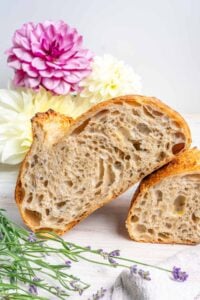
Lavender Vanilla Sourdough Bread
Learn how to make this fragrant, floral, and herbaceous Lavender Sourdough Bread with vanilla and lemon zest.For more tips, details, and photos, follow the guide above that includes step-by-step instructions.
Yield or Serving: 1 loaf
Equipment
- 1 Cast Iron Dutch Oven, I use the Challenger Bread Pan linked here with fantastic results, but another cast iron dutch oven works well too
- 1 Dough Whisk, optional but helpful
- 1 Brød and Taylor Folding Proofer, optional but helpful
Ingredients
Levain
- 30 grams Sourdough Starter
- 30 grams Bread Flour
- 30 grams Water
Lavender Vanilla Sourdough Bread
- 350 grams Bread Flour
- 50 grams Spelt Flour, or whole wheat flour
- 316 grams Warm Water
- Levain, see above, or 90 grams of active sourdough starter
- 9 grams Sea Salt
- 2 TBS Dried Lavender, 4 grams
- 1 ½ tsp Vanilla Paste, or vanilla extract
- 1 TBS Lemon Zest, from 1 lemon
Instructions
- Make the Levain:In a clean jar, mix the sourdough starter, bread flour, and water for the levain.Cover and set in a warm location (between 75-80ºF) for about 4-5 hours until doubled and bubbly.Alternatively, skip making a levain and use 90 grams of active sourdough starter below.30 grams Sourdough Starter, 30 grams Water, 30 grams Bread Flour
- Autolyse:About an hour before the levain is ready, mix together the bread flour, spelt flour (or whole wheat), and warm water in a mixing bowl.Make a well in the center of the flour and pour in the warm water. Use a dough whisk or your hands to mix together the flour and water just until it comes together.Cover and rest in a warm location for an hour.350 grams Bread Flour, 50 grams Spelt Flour, 316 grams Warm Water
- Add Levain, Salt, Inclusions, and Mix:Add all of the levain into the bowl and dimple it into the dough. Then, stretch and fold the dough for a few minutes to incorporate.Cover and rest in a warm location for 30 minutes.Sprinkle the salt, lavender, vanilla paste, and lemon zest on top. Dimple into the dough with your fingertips. Stretch and fold the dough for about 5 until thoroughly mixed and the salt dissolves.Cover and rest in a warm location for 30 minutes.Levain, 9 grams Sea Salt, 2 TBS Dried Lavender, 1 ½ tsp Vanilla Paste, 1 TBS Lemon Zest
- Bulk Fermentation & Folds:At 78ºF (26ºC), bulk fermentation typically takes about 5 hours.During bulk fermentation, perform 4 or 5 sets of strong stretch and folds, spaced 30 minutes apart. Add more folds if the dough still seems very slack after the last set. Rest for the remainder of bulk fermentation.At the end of bulk fermentation, the dough should be smooth, feel full of air, have visible bubbles, and jiggle if shaken. The dough should rise about 75%.
- Shape:Lightly flour the top of the dough and the counter. Gently loosen the dough from the sides of the mixing bowl and turn the dough out onto the counter.With the help of a bench scraper, shape the dough into a batard (oval) or boule (round). Shaping images are above in guide.Lift it up and place it into a floured banneton.Stitch the dough in the banneton if it's still slack.
- Cold Overnight Proof:Place the covered banneton into a refrigerator to proof overnight and for up a couple of days.
- Bake:Place the empty Dutch oven with lid in the oven and preheat for an hour at 500°F (260ºC).Once preheated, remove the banneton from the refrigerator and turn the dough out onto a piece of parchment paper or a reusable bread baking mat. Score the dough with a sharp bread lame about ¼-½" deep.Transfer the scored dough to the Dutch oven and cover it with the lid.Bake at 500°F (260ºC) for 20 minutes. Remove the lid, lower the oven temperature to 450ºF (232ºC) and bake for about 15 minutes with the lid off.Remove from the oven and cool on a wire rack for at least an hour before slicing.Slice and enjoy! This loaf is particularly good with butter and a drizzle of honey, creamy cheeses, picnics, Mediterranean dishes, or served with savory, rich stews.
Notes
- Try to keep the dough at a constant, warm temperature (between 75-80ºF) as much as possible throughout fermentation. I use the Brød and Taylor bread proofer to keep my dough at a constant 78ºF. If your dough and environment are cooler, bulk fermentation will take longer. Conversely, in warmer conditions, the dough will ferment faster.
- Read my guide above for a detailed walkthrough with photos and videos for shaping, scoring, and baking this bread.
Tried this recipe?Rate the recipe above, comment, and share @sourdoughbrandon on Instagram & Facebook